Health

For more information concerning work and views related to Health, please contact our office.
More on Health
WASHINGTON, D.C. - Today, the Health Resources and Services Administration announced a $750,000 award to Princeton Community Hospital Association as part of the Rural Residency Planning and Development program. Funding is used to expand and improve access to health care in rural areas, supporting start-up costs to create new rural residency programs, including Rural Track Programs (RTPs), in qualifying medical specialties. |
WASHINGTON, D.C. — Today, Congresswomen Carol Miller (R-WV) and Terri Sewell (D-AL) introduced legislation to amend the United States tariff schedule to establish new tariff classifications for silicone breast prosthetics and mastectomy bras. The bill will make these important medical products more accessible and affordable for women who have undergone breast cancer treatment. |
WASHINGTON, D.C. – Today, Representatives Carol Miller (R-WV), Deborah Ross (D-NC), and Don Davis (D-NC) introduced the Virtual-Based Opioid Treatment for Veterans Act. This bipartisan legislation would establish a Department of Veterans Affairs (VA) pilot program that would connect veterans with opioid use disorder (OUD) to community-based virtual treatment providers when the VA cannot provide timely care directly. |
Washington, D.C. - Last week, Rep. Carol Miller (R-WV), joined her colleagues, Reps. Jill N. Tokuda (HI-02), Jack Bergman (MI-01), Shomari Figures (AL-02), Maxine Dexter (OR-03), Tracey Mann (KS-01), Sharice Davids (KS-03), Jeff Hurd (CO-03) and Lauren Boebert (CO-04), in introducing bipartisan legislation to strengthen rural hospital infrastructure and enhance patient care.
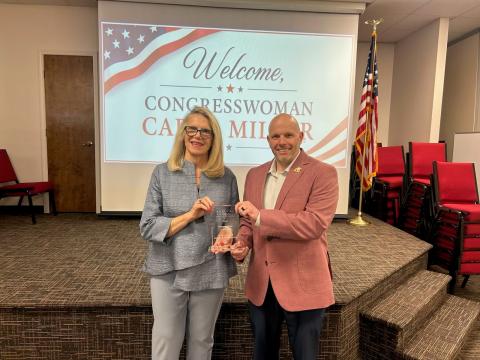
Washington, D.C. – Congresswoman Carol Miller (R-WV) and her colleagues on the Ways and Means Committee held a hearing to investigate health care affordability for all Americans by examining the role of health systems. The hearing featured top executives from four diverse health systems. Members had the opportunity to examine these systems’ evolution from hospitals into consolidated health care conglomerates and inquire whether this reality is in the best interest of patients or whether it contributes to rising costs for families and taxpayers.
Washington, D.C. – Congresswoman Carol Miller (R-WV) and her colleagues on the Ways and Means Committee held a hearing to examine potential waste, fraud, and abuse within Medicare payment systems as well as the effect of fraud on Medicare providers and patients. During questioning, Congresswoman Miller discussed pervasive fraud within hospice and home health operations. A video and full transcript of Congresswoman Miller’s questions and provided responses can be found below.
Washington, D.C. – Congresswoman Carol Miller (R-WV) and her colleagues on the Ways and Means Health Subcommittee were joined by Secretary Robert F. Kennedy Jr. for a hearing to discuss the priorities and policy proposals from the Department of Health and Human Services (DHHS) under the Trump Administration.
Washington, D.C. – Congresswoman Carol Miller (R-WV) joined her colleagues on the Ways and Means Health Subcommittee for a hearing examining the persistent challenges in end-stage renal disease (ESRD) care, including stagnant patient outcomes, barriers to innovation, and disparities in access to treatment.